
Fit help
How should a bra fit?
The size on the label is only half of it. Use these five checks when you try a bra on, then work through anything that feels wrong.
Sources checked

Five signs of a good fit
- 1
Band
Firm and level all the way round, front to back. Freya’s fit advice: the underband “should fit firmly and be level all around the body”.
- 2
Cups
Breast tissue sits inside the cup with no spilling over the edges and no empty space or wrinkles.
- 3
Centre front
On most underwired styles the centre front sits close to your chest. Plunge styles are designed to sit lower.
- 4
Wires
They sit around your breast tissue, in the fold where your breast meets your chest, not on top of the tissue.
- 5
Straps
They stay on your shoulders without digging in. Curvy Kate suggests you should be able to fit two fingers under each strap.
Common fit problems
One sign rarely means one size change. Each of these has more than one possible cause.
-
The band rides up at the back
If the back sits higher than the front, the band is usually not firm enough to stay level. Freya’s guidance is that a band riding up at the back means the back size is too big. Check strap length and the hooks you use first.
-
The band feels tight
Firm is right; painful is not. New bands are meant for the loosest hooks, and cups that are too small can make the band feel tighter than it is.
-
The cups gape or wrinkle
Empty space all through the cup can mean the cup is too big. A gap only at the top edge is often the cup shape, not the size, so try another style first.
-
The cups overflow
Tissue spilling over the top or at the sides usually means a cup that is too small, or a neckline cut lower than suits you.
-
The straps slip
Straps stretch over time, so shorten them first. A band that rides up also pulls straps outwards, and wide-set straps suit some shoulders better than others.
-
The straps dig in
Straps that dig in are often tightened to make up for a loose band. Check the band is firm before tightening straps.
-
The wires dig or poke
Wires should sit in the fold under your breast. A wire on breast tissue can mean the cup is too small; a wire poking through the fabric means the bra is worn out.
Fit checker
Work through a fit problem
Pick what feels wrong and answer a few questions. You get a list of things to check, in order, before changing size.
Your answers stay on this page and are cleared when you leave it.
Step 1 of 3: choose a problem
When a fitting is the better option
Several UK brands recommend a professional fitting over a tape measure. Panache says it “would always recommend you have a professional fitting”, and Bravissimo’s fitters fit by eye using the bra you are wearing. A fitting is worth it if your size keeps changing, the checks here do not settle a problem, or you need a band or cup outside the usual range.
Fit questions
How tight should a bra band be?
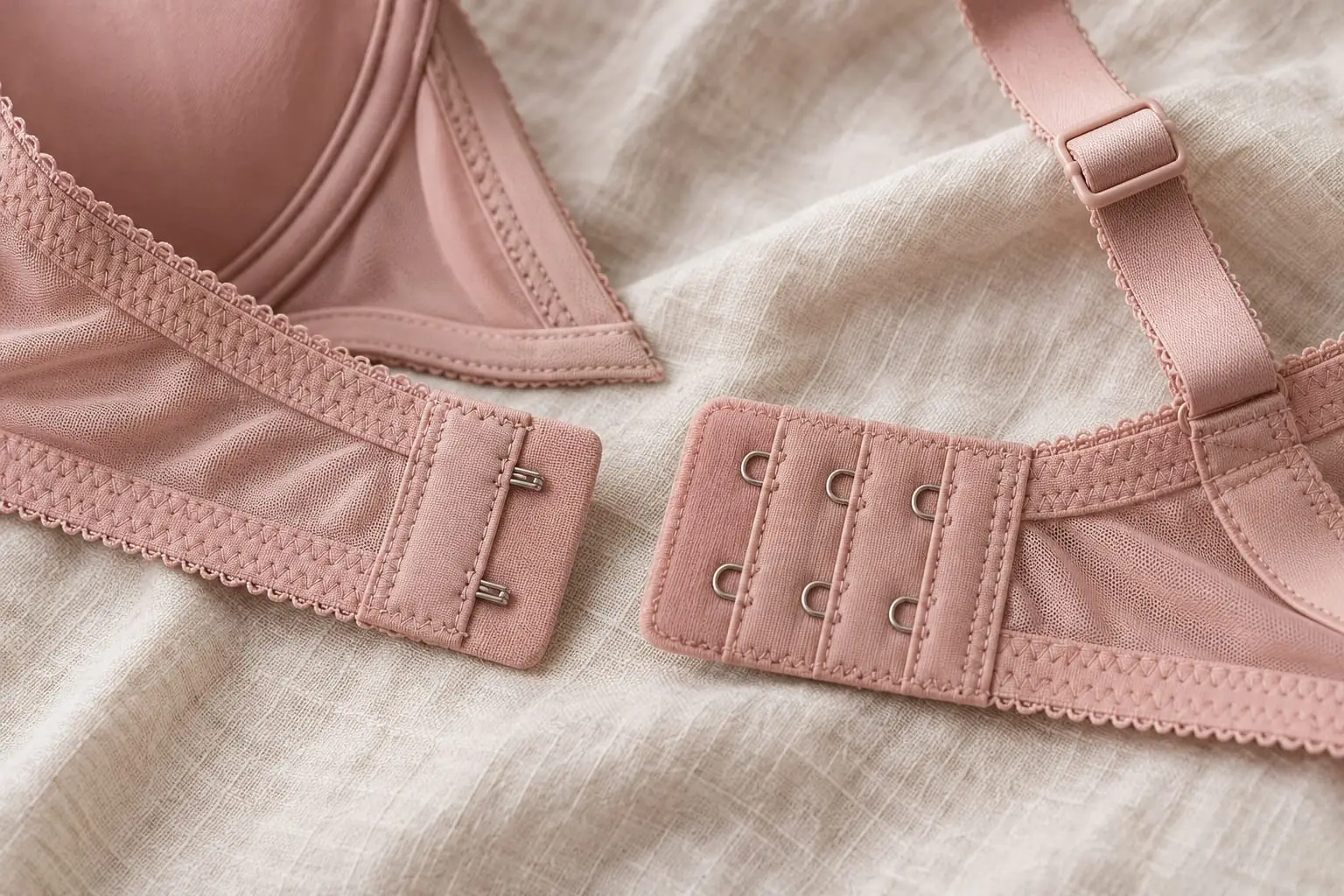
Which hook should a new bra fit on?
How often should I check my size?
Sources
Checked . Brands change their charts, so check the retailer’s own size guide before you buy.
- S11 Freya: The perfect fit (opens in a new tab) Fit checks for band, cups, centre front and straps
- S7 Curvy Kate: Bra fitting tips (opens in a new tab) Fit checks for band and straps
- S4 Boux Avenue: How to measure bra size (opens in a new tab) Tape method; worked example 39 − 34 = 5 (DD); sister sizes; limits of measuring
- S1 Brastop: How to measure your bra size (opens in a new tab) Tape method; inches-to-cup table (A to K); rounding rules
- S15 Panache: Fit guide (opens in a new tab) Professional fitting advice; UK cup range
- S17 Bravissimo: Bra fitting guide (opens in a new tab) Fitting without a tape measure; sister-size logic
- S13 Fantasie: Bra fitting FAQs (opens in a new tab) Size range; advice on refitting